
Wrist And Ankle Weights In UpBeat Pilates
To weight or not to weight? That is the question.
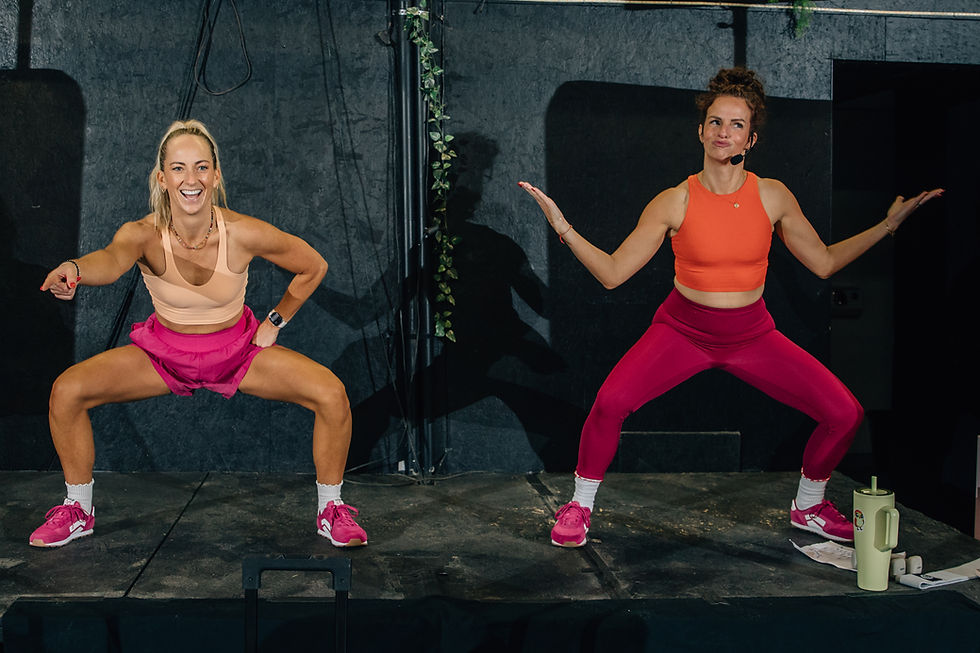
In UpBeat Pilates, we love a good challenge. We love that strong, confident post class high while also occasionally questioning our life choices halfway through a particularly spicy song (hello Shakedown).
A question that comes up frequently is whether participants should wear wrist or ankle weights during UpBeat Pilates.
Our answer? We don't encourage them, but we don't necessarily discourage them.
Let's break it down (Hammer time!)
Form First. Resistance Second. (Oh hello FDA, is that you?)
Before we ever consider adding resistance to a movement via accessories like a band or weights, we want participants to remember two important things:
Proper form and control. Can they execute the movement with stability, alignment, and intention?
Full, functional range of motion. Can they move through the intended range without compensating, straining, or sacrificing technique?
Pilates is about intentional movement. When we add resistance before a participant has developed the strength and control to support it, we risk shifting the focus away from the muscles we're trying to strengthen.
While we love lots of spice in our workouts, we don't want to add so much that our recipe tastes bitter.
By adding wrist or ankle weights, we may unintentionally encourage compensation patterns that diminish the quality of the movement instead of creating an effective exercise. We want participants to earn their resistance through strength, stability, and control—not simply adding weight for the sake of making something “harder”.
Sometimes bodyweight alone is plenty humbling. Just ask anyone who has done any of our 4 plus minute plank songs from the UpBeat library.
Work Should Be In the Muscles, Not the Joints
Wrist and ankle weights add resistance at the ends of our limbs, increasing the demand on the joints involved in a movement.
That isn't necessarily a bad thing. In fact, for participants who have developed adequate strength and stability, additional resistance may provide an appropriate challenge.
However, when participants lack the strength to control that resistance, they may begin to compensate through their wrists, elbows, shoulders, hips, knees, or ankle joints. While we love making some noise in an UpBeat class, we'd prefer our joints not be part of the chorus section.
Our goal is to create muscular engagement without unnecessary joint stress.
If adding weights causes a participant to shorten their range of motion, lose alignment, rely on momentum, or they experience joint discomfort, the resistance is no longer serving the purpose of the exercise.
The goal isn't to make the movement heavier. The goal is to make the movement better.
So, back to our original question, are wrist and ankle weights allowed in UpBeat Pilates?
Absolutely, but with some important considerations.
As an UpBeat Pilates instructor, we do not recommend actively encouraging participants to bring or wear wrist and ankle weights during class, and we do not recommend that you as the instructor wear them either. As we know, "monkey see, monkey do"...even if you have the ability and control to utilize wrist and ankle weights properly, using them as the instructor makes your class more likely to follow your lead, which could lead to injury or improper engagement.
Our choreography is designed to provide an effective workout without requiring additional wearable resistance. Trust us, we've got plenty of ways to make those muscles shake without adding accessories to the party!
However, we also recognize that participants come to class with different levels of strength, experience, and physical ability. Some participants may have developed the muscular strength, joint stability, and movement control necessary to safely incorporate light wrist or ankle weights into certain exercises. For those individuals, added resistance may be an appropriate option. This is where individual coaching comes into play.
Individual Conversations, Not Class-Wide Recommendations
If a participant asks whether they can use wrist or ankle weights, we encourage instructors to have a conversation with that individual before or after class. This provides an opportunity to discuss their goals, movement experience, and ability to maintain proper technique with additional resistance.
Some questions you might consider asking:
Can you maintain proper form throughout the entire movement without weights?
Do you feel the intended muscles working, or do you experience discomfort in your joints?
Can you maintain control and your intended range of motion when resistance is added?
Are you using weights to enhance an already strong movement pattern, or simply to make the exercise feel harder?
Remember, not every movement is appropriate for additional resistance, even for strong participants. A weight that feels manageable during one exercise may be too demanding during another.
Just because you can add weights doesn't always mean you should. Kind of like adding another scoop of pre-workout. More isn't always the answer (unless it’s Perk or hip sways, then ofc we approve).
As instructors, we can observe movement, offer modifications, and provide general guidance. And always remember to stay inside your scope of practice.
Quality Over Quantity
There are so many ways to increase the intensity of a Pilates exercise without adding equipment.
In a recent On Demand class you may have heard Kimberly say, “What if you did 10% less and found 10% more work?”
Think about that for a second.
What if you lifted your leg just a little lower but found more engagement through your core? What if you made your movement a little smaller but discovered more control, stability, and muscular connection?
Sometimes, by doing just 10% less, we actually find MORE of what we're looking for.
And that's the beauty of Pilates. We're not always chasing bigger movements, heavier resistance, or more repetitions. We're chasing better movement.
Of course, we still want participants moving through a healthy, functional range of motion. But there's a difference between moving through your available range with control and pushing beyond what your body can currently support. And sometimes doing less allows us to feel more.
Nothing humbles you quite like making a movement two inches smaller and suddenly discovering muscles you didn't even know were invited to class! If you’ve been around the UpBeat sphere for a while you know that sometimes, the most “advanced” version of an exercise isn't always the one with the most resistance. It's actually the one performed with the most control (hiya mind body - we love yew).
We want our participants to understand that adding weights is not a sign of being more advanced, just as choosing not to use them isn't a sign of being less capable.
Strength isn't measured by what you add to the movement. It's demonstrated by how well you execute it.
The UpBeat Takeaway (let’s wrap this baby up)
When it comes to wrist and ankle weights in UpBeat Pilates, our recommendation is simple:
We don't encourage them, but we don't automatically discourage them.
At UpBeat we prioritize proper form, full functional range of motion, muscular strength, and joint stability before adding resistance (FDA).
We don't promote wearable weights as a standard part of our classes, but we recognize that some participants may be experienced enough to use them appropriately. However, please do not utilize them as the instructor.
Those decisions are best addressed through individual conversations rather than blanket recommendations to an entire class.
As instructors, our job isn't simply to make exercises harder. It's to help participants move better, build strength, and feel successful in their bodies.
So before you add 10% more resistance, ask the question, “Can you find 10% more intention in the movement you already have?
Intentional movement will always matter more than added resistance.
And if your muscles are already shaking to the beat? Congratulations. You're probably getting plenty of resistance from gravity herself and she's never missed a class!


Comments